Saturday, June 15. We have been anchored in Dead Point Bay for a couple of days. Yesterday we found a trail so we hiked it and ended up in the First Nation village called New Vancouver. Actually, they call it Tsatsisnukwomi, which means “place of the eelgrass.” It’s not clear to me why they let us call it New Vancouver, instead of, say, Eelgrass. Maybe they had no choice as the Canadian government so kindly gave it back to them, after forcing them to leave back in the ‘60s.
The people in Tsatsisnukwomi are descendants of the original villagers. They have built a long house complete with family totems. These people originally came from Knight Inlet. They had four villages there, but were mostly wiped out by smallpox. They moved down here next to the village of Mamalilaculla, which they married into.
The two-headed serpent represents the choices we all have to make (yin and yang?). The bear at the center is one of the clan totems. Totems at the head of the dock next to the “welcome” sign (above). At the top is the Thunderbird and at the bottom is the bear, both Clan totems. In the middle is a woman holding an unborn child. The woman is an ancestor, the unborn child represents a prophecy that this child would bring the people back together. This child was the man, recently deceased, who built this village and brought his people here. Longhouse for gatherings (potlatches, ceremonies…). The left totem, top to bottom, depicts the Thunderbird, orca, and bear Clan totems. On the right, top to bottom is a supernatural bird whose name I can neither pronounce nor spell, and another supernatural being who welcomes the deceased to the next world. This totem pole was erected in memory of deceased family members. The paintings on the house itself are exact replicas, taken from black and white photos of the original village. They depict Clan ancestors and totems for each of the four villages. The woman of the prophecy is on the far right.
Thursday, June 13. We’ve been hanging around Blackfish Sound for the last few days. Roger mostly doesn’t come here. This group of islands is called the Indian Islands. They are low with narrow channels full of rocks and shoals that are named things like Beware Channel and Dead Point. These islands were and still are inhabited by First Nation peoples. There are many old, abandoned villages, graveyards and petroglyphs.
We anchored two nights in Parson Bay so we could troll for salmon. Guidebook says salmon fishing is good around there. We didn’t find it so, but perhaps it’s too early. We didn’t see many fish on the sonar and we caught nothing. I did catch another sculpin at anchor, but I threw him back. They are three quarters head so even when they look fairly large, you cut off the head and there ain’t much left.
Blackfish Sound from entrance to Parson Bay. This is where (and when) we saw the whales.
Not counting pilot whales, we saw whales for the first time yesterday. We weren’t very close, but something HUGE surfaced with a big blow off in the distance in Blackfish Sound just in front of Hanson Island. We were on our way back from fishing (as opposed to catching), just heading down Parson Bay back to our anchorage. Then we saw several more spouts. It was a whole group of some kind of BIG whales. Wish we had been closer.
The birds, seals and sea otters are plentiful. We have seen many eagles, Canada geese, herons, loons, mergansers, scoters, pigeon guillemots, a host of smaller songbirds along with crows and ravens. I love the calls of the loons and the pigeon gillemots crack me up during take-off and landing. They are smallish, black with white on their wings and bright orange feet. When they take off and land their feet are going ninety miles an hour running across the water.
Parson Bay had many small coves suitable for anchorage but, for reasons we can’t ascertain, they are not marked as such on any charts or in the guidebooks. We have learned to look for good spots that AREN’T in the guidebooks if we want the place to ourselves. But we have also had other, more experienced boaters ask with incredulity, “You anchored THERE???” Maybe we’re just stupid but we had a perfectly good anchorage all to ourselves in Parson Bay. Yesterday we went around the corner to an anchorage (listed on the charts and in the guidebooks) between Harbledown Island and small Mound Island. There were five boats there and it was unimpressive. The wind blew all night through the cut between the islands, along with current.
Head of Parson Bay, Harbledown Island.
Today we found a nice anchorage behind Dead Point on Harbledown Island. There are the remnants of some stone walls here that are supposed to be from an old homestead. No sign of buildings. The walls incorporate trees here and there and then just seem to end. Maybe there was some wooden fence that is now gone. There’s a high cliff on one side that might have been part of the enclosure.
Here’s Alan, holding up the walls.
There is a First Nation village just over the ridge from here. We found the trail and will hike over there tomorrow. They give tours of the longhouse and whatnot.
Monday, June 10. We are at the dock in Port McNeill and have four bars on Roger! I have a confession to make: we haven’t actually seen Roger since about Powell River, or somewhere around there. Lately it’s been Telus or Bell. But I like Roger so, Roger it is henceforth.
When Alan came back to the boat after paying moorage fee there were two large bald eagles sitting on top of the brown building. They stayed until someone started walking up the ramp, then flew off to sit on top of a nearby boat.
It’s been raining off and on for over a week now. We had to light our diesel heater and we are glad to have it.
We were a bit nervous coming here as we had to come back through the very northern part of Johnstone Strait, into the shipping channel and through tide rips. But we timed the tide perfectly and we only saw one ferry and one tug. Piece of cake.
Blackfish Sound and the Broughtons are full of narrow channels, rocks and islets. (Blackfish is another name for pilot whales, and we saw many coming across Weynton Passage.) The main challenge is timing the tides and currents along with keeping track of wind direction. Even if the current is only 2 or 3 knots, traveling against it is a slog. Problem is, helpful tides and currents are often not at the most convenient times!
Today we are heading back to Blackfish Sound to fish in Parson Bay.
Update: Monday, June 10. We decided to take the dinghy through the passage and explore the back lagoon. We had to time this carefully because the current is a whitewater river any time other than slack. We waited until 4pm. Tide was supposed to turn around 5:30. This would give us some current going and if we spent an hour or two exploring, we would return close to slack. We headed out and as we got close to the passage, the current was still pretty strong. We looked ahead and saw whitewater at the other end. Thought about turning back but it would have been a hard row back at that point. We decided to head on through. It was a fun ride! Good thing we spent so much time whitewater rafting back in Oregon!
We drifted down to the end of the lagoon and it was really lovely. We forgot the camera so we have no photos. It was quite a distance to the other end, maybe 3/4 mile. We took our time rowing back hoping the current would be slack by the time we got to the passage. It wasn’t. There was no longer whitewater, but the current was very strong at the narrowest part and we very nearly didn’t make it. (We would have had to go back and wait awhile longer.) We couldn’t figure out why it hadn’t turned. Got back to Calliope, looked at tide graph and realized we had been looking at tides for the next day!!! Yikes!
Saturday, June 8. We left Lagoon Cove because we didn’t want another night of generator noise. What a luxury to just pull anchor and go when conditions are not ideal. We are in a narrow little inlet that has an even narrower and shallower inlet at the back that opens into another lagoon. We are waiting for high tide to row back up there. Right now it looks like a river.
Back of Pott’s Lagoon. Note the whitewater.
Incredibly, there are six floating houses in here. Only one is occupied right now. Must be summer fishing cabins.
Floating houses in Pott’s Cove
Tomorrow we plan to make a run to Port McNeill for provisions, then go explore the Indian Islands in Blackfish Sound.
Saturday, June 8. On Thursday we left Boughey Bay and motored up very narrow Chatham Channel. After transiting the channel, Alan drove around Minstrel Island while I put out my trolling gear. I had a very nice salmon on the line but the line broke and he got away with my lure. I put on a 50lb-test leader, we went around the corner and caught this monster sculpin. He’s ugly but tasty. About four meals in him. Still, I want salmon!
Sculpin caught just off of Turnour Island.
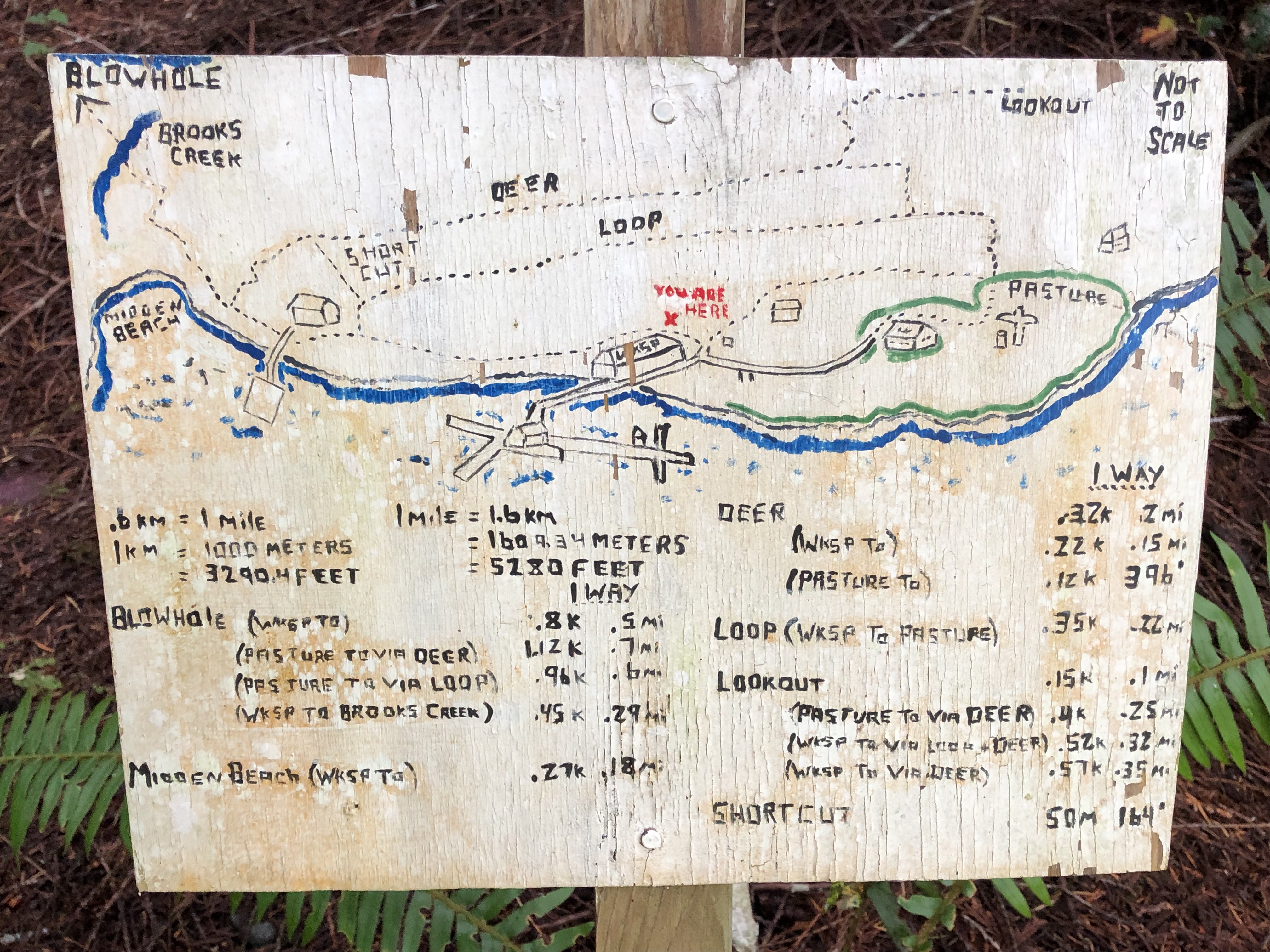
Just after we caught the sculpin it started raining like crazy so we went and anchored in Lagoon Cove, East Cracroft Island. It was a nice lagoon, very well-protected, but lots of generator noise. Friday morning we rowed over to the marina and hiked one of their trails. The trail ended overlooking a narrow channel called the Blow Hole. And there lay a big pile of fresh bear scat. When we got back to the marina, we notified them about the bear and the guy said, “oh yeah, we saw a bear up there yesterday when we were coming up the Blow Hole.” I didn’t think to ask what kind of bear he saw. Best not to know.
I’ve been carrying around a whistle and an air horn to scare off bears if I see any. Then a guy at the dock asked me, “do you know how to tell grizzly scat from black bear scat?” I said, “no, how?” He said, “the grizzly scat is full of horns and whistles.”
Trails on East Cracroft Is. Note air horn strapped around my waist.
Monday, June 3. We would have liked to stay awhile in Forward Harbor but a window of opportunity opened up to get across the 15nm of Johnstone Strait that we had to traverse. There have been gale force west winds through there for weeks creating a no go for us. This break allowed us to get all the way through with a following current. She was smooth as glass for the last few miles. What a relief. We travelled 28nm today which I think is a record. We will rest here for a day or two before heading up to the Broughtons.
Johnstone Strait can be placid.
When we pulled in here there was a little black bear on the beach, turning over rocks, looking for lunch. I got some fuzzy pictures of him. Wish I had a telephoto lens.
Black Bear in Boughey Bay IBlack bear in Boughey Bay II
June 4. We took the dinghy out for a look round at low tide today. Went over to the opposite side of the bay and spotted another black bear. Rowed in closer and this bear was brown. Another grizzly. Alan says, “get closer!” I said, “are you crazy?” (expletives deleted) Good thing he isn’t the captain!!!!
Grizzly in Boughey Bay I Grizzly in Boughey Bay II
Monday, June 3. Yesterday we left Phillips Arm, buzzed the grizzlies on our way out and headed down Cordero Channel toward Greenpoint Rapids. We weren’t intending to go through the rapids, but only to anchor in the Cordero Islets just before the rapids to position ourselves for transit today. We arrived at the rapids one hour before slack. The two boats in front of us gave the whirlpools at the bottom a wide berth and went on through. So, we followed those guys. We had the current with us or I would not have attempted this. I clocked us at 11kts a couple of times. But we cruised on through. I could get used to traveling at 10kts!
The next rapid is about 10 nautical miles down Chancellor Channel and up Wellebore Channel. We now planned to anchor in a little nook at the bottom of Chancellor right across from the entrance to Wellebore, in position to run Whirlpool Rapids the next day. But just then we were passed by Rogue, a big powerboat run by Pat and Dan whom we had met at the dock in Shoal Bay. We got on the radio and said, “hey guys, where you headed?” They said they were going up to Whirlpool. We asked weren’t they gonna wait until next slack? They said no, they were gonna catch the last of the ebb.
We double checked our current tables. Whirlpool was due to turn to flood at 0920. We looked at the clock. 0920. Did they screw up? Should we call them back? Heck no, if they can do it, so can we! So, we followed those guys! Ebb lasted an extra half hour or so because of the freshwater glacier melt previously discussed (Dent, Yaculta and Gillard rapids). By the time Rogue went through Whirlpool, we were about half an hour behind them. We got there an hour after the current was supposed to have turned. We were gonna go for it and we would have made it except what to our wondering eyes did appear? A tug with a half mile log boom heading through the rapids toward us.
Yikes! (This was a different tug taken as we were leaving Forward Harbor, but you get the idea.)
Alan says, “oh just go on up there and see what happens.” I said, “are you crazy?” Actually what I said was somewhat stronger than that but this is the public interweb and all. Instead I veered into a little bight just SW of the rapids. We dropped the hook, had a lovely lunch and waited for the next slack. At slack, we went on through and anchored in Forward Harbor for the night. Another beautiful place. Furry eyeful alert.
Will update with pictures when I can get better cell reception.
Cordero Channel, looking east from entrance to Phillips Arm. Wellebore Channel, looking SE from Whirlpool Rapids. Forward Harbor.
Monday, June 3. We got our fuel pump on Friday, installed it and headed up Phillips Arm Saturday morning to test it out. We pulled into a small bight and as we were setting anchor, we spotted this guy on shore:
Grizzly, Phillips ArmHere he is again.
Images are a bit fuzzy because, well, we didn’t want to get any closer. There were two grizzlies grazing here, this one and a larger, lighter brown one that we think might be the mother of this one. We didn’t get a good, fuzzy picture of her. Our anchorage was windy, we couldn’t go ashore (CHOSE not to go ashore), and tour boats with dozens of people kept buzzing in to show people the grizzlies. Wonder how much folks paid for that! Anyway, we ate lunch and decided to pull anchor and head further up channel. We found a nice spot to spend the night and watched the grizzlies come and go from a bit more distance.
Thursday, May 30. We arrived at the government dock here at Shoal Bay on Tuesday after traversing Dent Rapids with no difficulties. We needed to check the engine because we developed a fuel leak awhile back. Turns out our fuel pump needs replacing. We are not exactly stranded but it will become more difficult and more expensive the further we go. As it is, the nearest place that has one is in Campbell River. It will be delivered by water taxi tomorrow. You don’t even want to know what it is going to cost.
Well, there are worse places to be delayed. Check it out:
View from the pub at Shoal Bay
There is one bar, but it ain’t Roger:
One bar on Shoal Bay, no bars on Roger.
The pub does have WiFi but the WiFi does not reach the docks. There’s a marketing ploy! So, you can guess where I am sitting right now. The proprietors, Mark and Cynthia are very nice. They have a pick-your-own organic garden. Not much ready yet but I did get some flowers and kale. I also found some bistort growing by a stream. The place is really lovely with streams, bridges, small waterfalls and Cynthia’s pottery everywhere.
Happy hour at the pub. Trail, Shoal BayGarden, Shoal BayTulip accompanied us down the trail. Natural water “sculpture”. How much did they spend at the Butchart Gardens to create these? Just in front of this is a bench surrounded by yarrow and heather. Grounds at Shoal Bay.
While we wait I’ve done laundry and repainted the bottom of my kayak. If all goes well tomorrow, we will leave early Saturday morning, heading down Cordero Channel. We plan to anchor inside a small bay surrounded by a group of small islands called Cordero Islands. These are right before the next set of rapids, Greenpoint. We don’t expect to see much of Roger, but will check in when he shows up.
View down Nodales Channel from Cordero Channel. We passed a lone kayaker here. Now that’s intrepid!
Monday, May 27. We made it through Yaculta Rapids and Barber Pass with no trouble. It’s all in the timing. Hard to believe that what we passed through becomes a raging river with tide rips and whirlpools four times per day. Also there is an issue with the tide/current tables. They can’t take into account the amount of runoff from snow/glacier melt (when in spring is it heaviest?). Since fresh water is lighter than salt water it stays on top, thus the apparent current can be an “outflow” even when the tide is coming in. Today when we came through Yaculta we should have been going against a 1 to 2 kt current and instead we were going 3+ kts with the engine at idle. (We had to keep slowing down to avoid arriving too early.) There are sightings of 10 ft overfalls where the salt water is going under the fresh water during a spring flood tide. This we do not want to ever see. Unless we’re standing on a cliff looking down. We took Barber Pass instead of Gillard Pass since we weren’t trying to do all three (Yaculta, Gillard and Dent) in one day. We will traverse Dent tomorrow. Since the weather is so calm, no wind or waves, and we had that unexpected following current, we probably could have done all three. The three rapids cover about 4nm. Our boat is relatively slow (4-5kts) and the timing is tricky heading north. Heading south is easier because the tide turns first at Dent, then Gillard, then Yaculta, in the direction of travel. (Incoming tides are from north to south here.)
Though we have to traverse five rapids, we chose this northern route to avoid Johnstone Strait. Besides the rapids and tide rips in Johnstone Strait, the prevailing wind is northwest from Queen Charlotte Sound. Avoiding wind against current situations puts one traveling always against both wind and current. In addition, Johnstone is the main shipping channel with the Alaska ferry, huge cruise ships, cargo ships, tugs with barges and fishing boats. Dodging navigational hazards becomes much more difficult while also trying to avoid being run over by a tanker! Up here, we’ve mostly had the place to ourselves.
We pulled off into a lovely little cove called Mermaid Bay to spend the night and wait for tomorrow’s tide. This bay is a traditional stopping point between the rapids for slower vessels, especially tugs pulling barges of log booms. There are no other boats here now. The bank above the bay is filled with signs, looks mostly like the names of boats. Approximately in the middle of the photo, just below and to the right of the “Stormforce” sign, is an old, dead tree snag with two branches pointing skyward. Someone has attached a float for a head and added a hard hat and life vest. You’ll have to zoom in to see it. How did they get up there? Maybe the bigger question is: why?
At the back of Mermaid BayFrom Mermaid Bay looking toward Dent RapidsFrom Mermaid Bay looking toward Gillard Passage




 The Great Adventures of Alan and Nancy